Meet the network: Friedensaktivistinnen verschaffen sich Gehör
Die Wege, die zum Friedensaktivismus führen, sind so vielfältig wie die Geschichten der Frauen, die wir hier erzählen. Viele von ihnen haben unvorstellbare Widrigkeiten, Verluste und Entbehrungen überwunden, um zu dem zu werden, was sie heute sind: Friedensaktivistinnen, deren Stimmen Gehör finden. Wir hoffen, dass ihre Geschichten Friedensaktivist:innen überall inspirieren werden.
Die Lebenswege dieser fünf afrikanischen Friedensaktivistinnen stehen beispielhaft für den Mut und die Beharrlichkeit von Frauen, die sich in von Konflikten betroffenen Ländern und Regionen für Frieden einsetzen. Ihre Geschichten zeigen auch, welche Hindernisse Frauen und feministische Friedensaktivist:innen überwinden müssen, damit die Stimmen der Frauen in allen Friedensprozessen Gehör finden.
Die Interviews wurden 2026 im Anschluss an das regionale Treffen in Uganda des Netzwerks Feminists Connecting for Peace geführt. Dort nahmen 23 Frauen und feministische Friedensaktivist:innen aus 18 afrikanischen Ländern teil. Während einige Frauen öffentlich bekannt sind, sind andere es nicht: Zu ihrem Schutz haben wir vereinbart, ihre Nachnamen hier nicht zu nennen.
Wir haben eine Illustratorin gebeten, ihren Weg als Friedensaktivistin nachzuzeichnen. Die Porträts sind nur auf Englisch verfügbar.
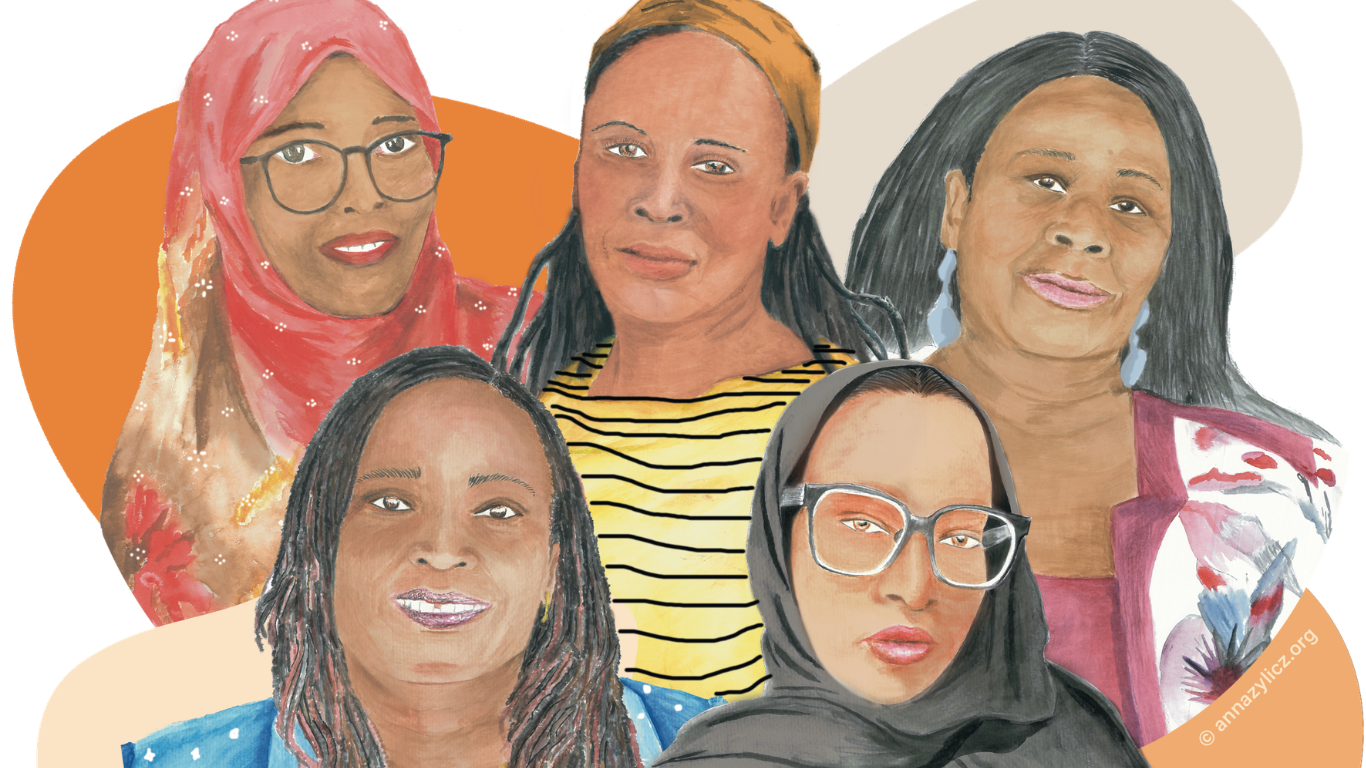
Amina, Somalia
“Governance can’t be separated from peacebuilding, that’s why we pushed hard to have women at government levels. When a conflict happens, it’s key to have women inside the system, so they are part of the committees solving it.”
Amina, born in Puntland, Somalia, fled to Kenya as a child when the armed conflicts began. But she returned years later, graduated from high school, participated in a women and peace leadership programme in the United States and continues to advocate for women's inclusion wherever decisions are made.
Aminata, Mali
“War has no limit. It means loss of lives, physical and traumatic wounds, family separation, the tearing of the social fabric (..) There must be a real dialogue with people who have lost everything. They are ready to discuss, to forgive and to make peace today.”
Born in Bamako, Aminata studied in Morocco. When the war started, her mother's village found itself at the epicentre. She soon joined KISAL, an organisation that collects and relays information on human rights violations and war atrocities throughout Mali. Soon after, she was appointed its director. Years later, Aminata spoke about the situation in Mali at the UN Security Council. Facing threats to her life, she is forced to flee Mali.
Bijoue, Ivory Coast
“It does take time to take care, women are always in resilience mode. Women are dealing with very deep wounds, and sometimes it makes them confrontational. Many are also affected at home, facing domestic violence, but they are still building peace.”
Bijoue's journey begins in Ivory coast, takes her to Ghana and leads her to the West Africa Network for Peacebuilding (WANEP), the largest civil society peacebuilding organisation in the region. Today, she works as Peace and Security advisor for the African Union.
Georgine, Democratic Republic of Congo
“Neither group ever spoke to the other. There were too many killings in this zone, we had to bring them closer [and] find a climate of understanding. I don’t have solutions, but I questioned them and I facilitated. I told them to empty out everything they had in their bellies – and they finally spoke and greeted each other.”
She was born in the Djugu territory of Ituri province to a Hema mother and a Lendu father, who - decades later - was beaten to death by a Hema armed group. In secret, she earned a degree in political science and administration. Today she is founder-coordinator of Femmes en Action pour le Développement Multisectoriel (FADEM) and participates in the provincial peace process.
Marian Angela, Sierra Leone
“The women were tired. Your husband, brother, male child, everyone was being conscripted. You were alone, but you didn’t have any means or power for yourself within society. So women said: ‘this burden is on us, we can’t leave it to the men.’”
Born in the Kailahun district of Sierra Leone, she became active in women's groups. When the war broke out, she was displaced to the capital Freetown. After participating in the 1995 World Conference on Women in Beijing, she and other women launched the umbrella organisation Women’s Forum Sierra Leone. That year, she participated in the women’s peace marches through Freetown. Today, she is active in the women’s peace movement through the Mano River Women Peace Network (MARWOPNET).